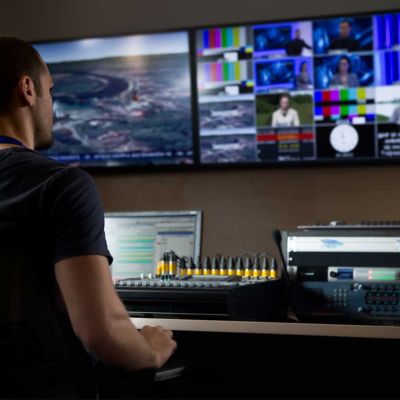


At Capital Captions, we truly care, not only about our clients (producers and video makers), but about their end client – the target audiences of our work, namely, Deaf, Hard of Hearing and Vision Impaired viewers worldwide. Our ethos focuses on accessibility being at the forefront of everything we do. Our professional closed captioning services and captions for childrens TV ensure that both children and adults alike can enjoy a wide variety of programmes and educational materials without barriers.
Captions for childrens TV
We work with captioning across many forms of video content: festivals, TV series, documentaries, corporate conferences, eLearning courses and so much more. No working week is the same, with so many diverse and engaging videos to caption, describe, interpret and edit… But when it comes to captioning, no genre is quite so engaging, enjoyable and rewarding to work with as captioning children’s content. In this blog, we’ll take a deep dive into our past and previous children’s TV captioning projects, what’s involved in kids TV captions and why Capital Captions is the best in this field! </span>
Closed Captions for Children’s Television and Streaming Programmes
Capital Captions are specialists in providing broadcast English CC for children’s video content. We have worked with a huge range of clients internationally, with some of our most notable projects and characters including:
- CeeBeebies
- Pablo
- Peppa Pig
- BBC Bitesize
- Super Movers
- BooSnoo
We are incredibly proud of the quality of the captions, BSL interpreting and audio description services we have provided, which have ensured inclusive, accessible content for children. Our approach is ensuring the best possible experience for viewers who rely on our services, and in case you’re interested, here’s what some of that involves and a run down of some of the most commonly requested formats for children’s television and online series, including BBC captions for educational content:
<ul>
- EBU-TT captions for BBC and broadcast content
- EBU-TT-D captions for online streaming content
- STL closed captions for US and UK streaming and broadcast
- CAP and SCC closed captions legacy formats for US and UK broadcast
- DFXP closed captions for Amazon, Apple TV and other streaming services
- SRT closed captions for widespread online use
When compared to TV for adults, children’s television shows are highly visual, often including longer sequences of music and frequent whimsical sound effects, with a high focus and emphasis on visual elements. While it’s important to include descriptions of sound effects where they may give further context and aid understanding, adding in too many caption descriptions in a children’s TV show is counterproductive.
<p><p><p><p><p><p><p><p><p><p><p><p><p><p><p><p><p><p><p><p><p><p><p>Overly descriptive captions can detract from the action onscreen, which is the main driver in understanding what’s going on. This is especially the case when it comes to animated cartoons or educational content with significant amounts of animated text and graphics onscreen.
Keep sound descriptions down to what is necessary.
Manageable caption reading speeds for children’s content
Children read slower than adults and therefore, captions on kids TV need to stay onscreen longer. 180wpm is the recommended maximum speed, as compared to adults shows with a typical maximum of 250wpm. While closed captions should be as verbatim as possible, it’s no use transcribing everything that’s said if there’s not time for the audience to read it! Lowering reading speeds on subtitles requires making decisions on where to split subtitles and if required, how to truncate speech (usually by removing filler words).
Word Choices in Children’s TV Accessibility
A large part of a captioner’s job is to choose the best word to describe things: the emotional tone of music, the loudness or spookiness or a door creaking or slamming. For many captioners, the process of choosing the best words can be equally enjoyable and frustrating, but for children’s TV, things change again.
It’s important to consider who is going to be reading onscreen captions. Using enormously long words, whether they are the best fit to describe things, is not always the best choice. Kids need to be able to understand what’s going on, focusing on the action in the show, not on what words in the sound descriptions mean.
Audio description is the process of describing visuals onscreen through the use of a narrator that describes what’s going on. The first element of audio description is writing the script. Similarly to captioning sound effects, sensible choices should be made in descriptions and things should be simplified. For instance, if a character were to pick up a ‘Philips head screwdriver,’ we would make a choice whether to describe it as such, or simplify to ‘screwdriver’ or even ‘tool’.
The choice will depend on the age group the video appeals to, the time restraints in terms of fitting in the narration, and the contextual importance of the item in question.
Lyrics transcription, colours and editing of CC for kids TV
Formatting and editing styles are incredibly important when it comes to creating closed captions for the Deaf and Hard of Hearing. Kids cartoons and TV programmes will often have dialogue mixed in with sections of singing. Lyrics should be transcribed and need to be formatted correctly so it’s clear they are not part of dialogue, in order to avoid confusion. This usually involves captioning lyrics in italics, enclosed within musical notes. Another convention in captioning lyrics in music is to avoid punctuation at the end of each subtitle line, which would be a standard in dialogue.
Identifying speakers is crucial for hearing impaired viewers. Placement is the standard choice for standard adult content, but for children’s TV, colours are a great way for the captions to blend in and tend to be preferred, especially as characters and speakers may change position more than in a typical adult TV show, so placement changes can potentially becoming confusing.
Using Tones in Children’s TV BSL Interpreting, ASL Interpreting and Audio Description
Here at Capital Captions work across all media accessibility services, including not only captioning and translation, but also sign language interpreting and audio description for the visually impaired. These services require actors, whose visual representations and/or voices should fit the tone of the video in question.
For BSL and ASL in-vision interpreting, there are a number of steps involved in ensuring that the final output video matches the tone of the source video. For children’s television, bright colours should be chosen for backgrounds, and they should ideally match the tones of the visual identity of the character or brand.
For example, when interpreting Peppa Pig, the background blue in the logo can be used as a background, where the pink would be overly dominating. In addition to the choice in background colour, the interpreter should wear block colours, so that movements are easy to see. The colour should also complement the background colour so they are easy to see.
The tone of an interpreter in a video aimed at children should be upbeat and friendly. Interpreting children’s content is more than sign language translation. It involves greater skill and a degree of acting in order to fit the tone of the video correctly.
In audio description, a voice artist will record descriptions of the visual content of a video in a track which overlays on top of the original sound. The tone of voice used by the voice artist is incredibly important, and the skill involved in striking the right tone makes audio describing children’s content a highly specialised skill. A serious tone over a preschool cartoon can completely ruin a video, whereas an overly child friendly tone in an educational video for children pre-adolescents may come across as patronising or awkward.
Whatever your requirements for your children’s TV show or educational series, Capital Captions are highly experienced and have you covered when it comes to captions for childrens TV. We provide a full range video and media accessibility services, including subtitling, closed captioning, translation, BSL interpreting, ASL interpreting and audio description. Contact us for a quote today.
Ready to make your videos accessible?
Get fast turnarounds, if you have a project you need subtitled, get your project started today.